
S. Concerto
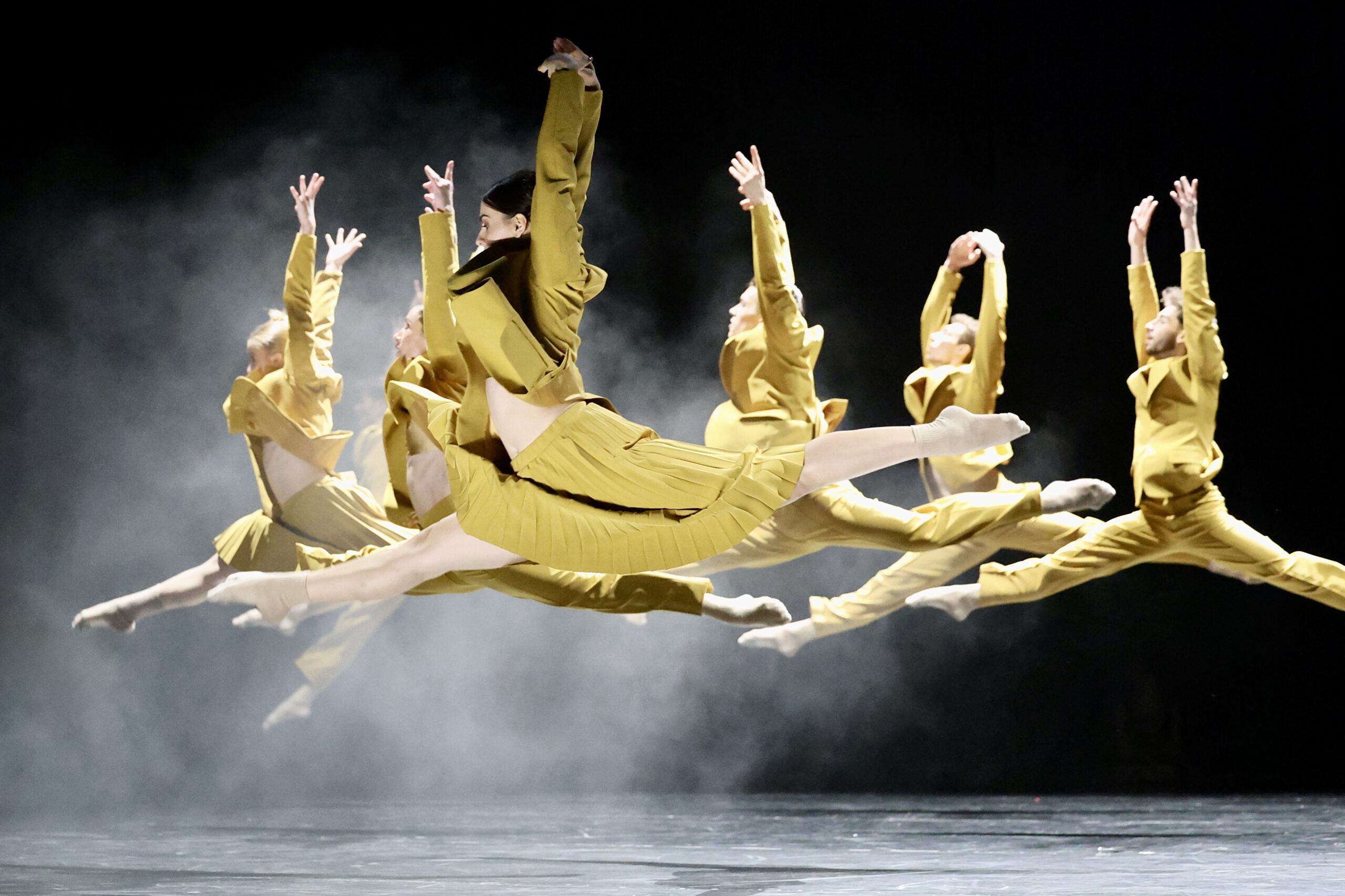
In the choreography by Iratxe Ansa and Igor Bacovich, the dancers are connected by invisible lines that constantly break, only for new connections to form, again and again. An electrifying energy emanates from them, as if we were watching atoms and molecules moving with varying degrees of intensity depending on the temperature — sometimes explosively, sometimes turning inward. Just like such particles, the dancers are connected by a magnetic force that is difficult to escape. And yet, they
keep trying.
For the choreographers, this is a deliberate form of theatricality, emphasised by minimalist lighting and a purist stage design. They achieve this through a mode of expression in which muscular exertion and physicality take centre stage. The resulting fluidity of the ensemble, from which duets and solos continually emerge in an organic, seamless flow, unfolds its full hypnotic power through sheer intensity, drawing the audience into a vortex where all sense of time and orientation disappears.
Don Quixote
The ballet focuses on the creative power of the human imagination. Don Quixote is unwilling to accept the reality so he escapes into his imaginary world which he created. The story of the ballet taking place at an office. Don Quijote is one of the officials, but he is the only one who refuses to accept reality for what it is and, under the impulse of the kindling flame of love, uses his imagination to break the boundaries of office, bringing him into conflict with the world around him, but not within him.
Don Quijote, Cervantes well-known hero, lives in a world created by his imagination. The ballet is, at its core, about the creative power of the human imagination. Unable to accept reality as it is, Don Quijote creates an imagined, dreamlike world within himself and around himself. The piece is, in effect, an absurd dream: the dream of its hero. With the power of his imagination, Don Quijote bursts the boundaries that life has drawn for him, and so comes into conflict with the world around him, a world that has no place within him. It is a world governed not by human values, chief among them love, but by the pursuit of money and material goods.
In the story I imagine, Don Quijote is an artist whose driving force, beyond ideas, is love. It glows in him as an inner source of energy and seeks an object. He projects it onto Dulcinea, a many-sided, many-faced, colourful personality. Money, material goods, life itself are transient… love is eternal.
Attila Egerházi