
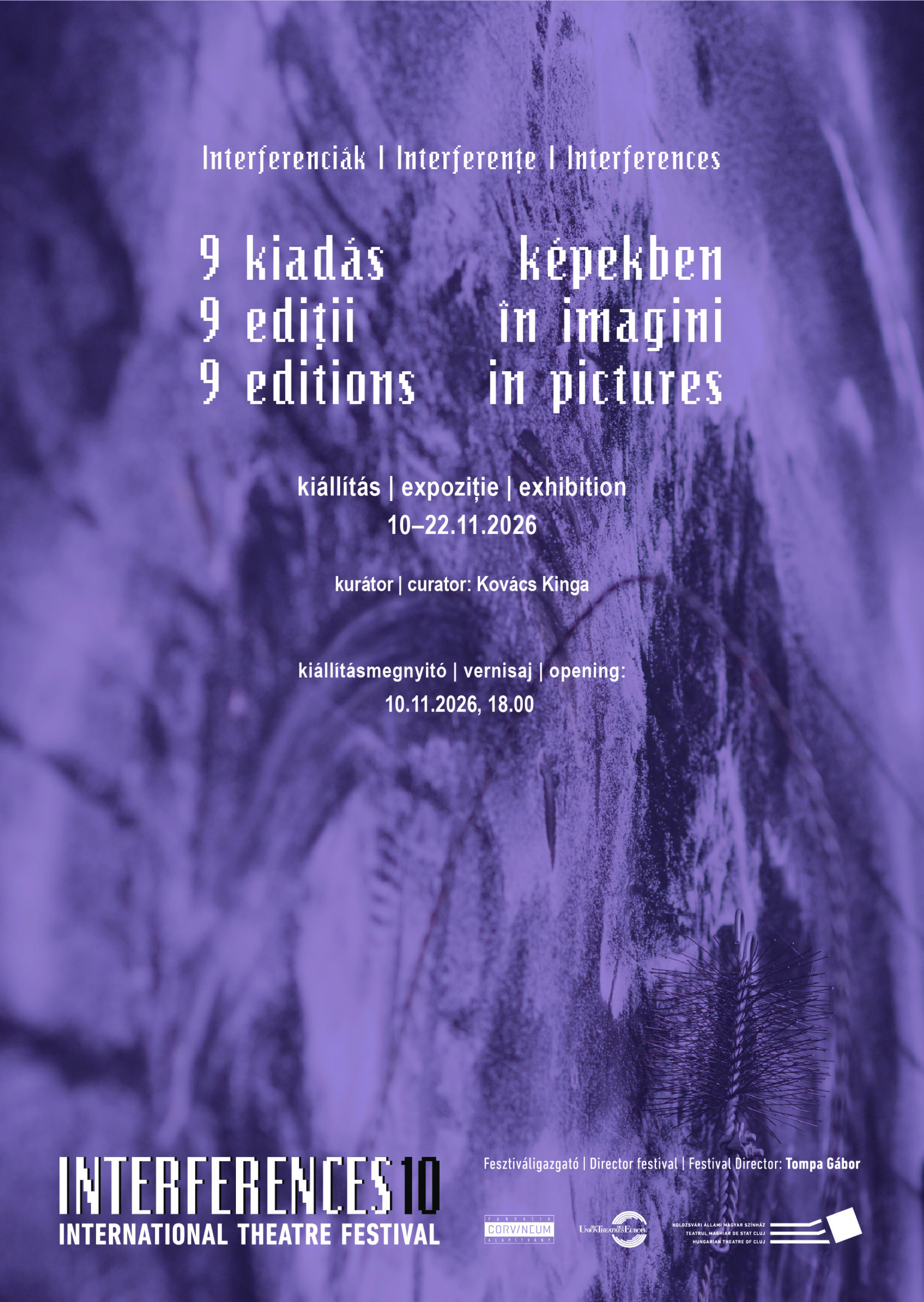
Placing the exhibition into the festival space, indeed, the interplay between space and time, past and present, is about the spirit of Interferences itself.
The nine separate stations showcasing the nine editions guide us through the spaces of the theatre, and ‘summons’ the spirit of the festival not as a document, not as the mere impression of bygone times, but as an event still pulsating and alive today, manifesting in the present: it involves the usual routes taken by the audience to performances and expert panel discussions, the locations of friendly chats often extending into the night, the well-known sites of repose within the building – all the spaces that form part of the history and the present of Interferences.
It is this scenography, this inevitable enclosure that lends the exhibition its framework. Of the many hundreds of photos, which is the only one capable of evoking that particular performance in as many of us as possible? Of all the photos commemorating the ambiance of the extra programmes and each festival day, which one best conveys the buzz of the festival? Of the retrospectives paying tribute to the various editions and analysing close to two hundred performances, spanning hundreds of pages, which one speaks the most candidly, the most suggestively, the most relevantly about the festival?
In line with the above constraints, the curatorial concept still sought some form of comprehensiveness. We wished to revisit not only the prominent events, companies and artists of the festival, not only its most memorable discussions, spaces and personages, but the festival in its entirety; the dialogue and the overall effect that Interferences has set as a goal from its first edition, and to which, we believe, it has stayed true.
In the enigmatic poster of the first edition of Interferences, a wristwatch is visible in a glass covered by protective foil, showing 2:15, as a reference to the 215 years of theatre in Cluj. The time capsule memorialised in the poster simultaneously preserves the 215-year past history of the theatre and that moment in 2017, the time of the first Interferences Festival. The watch, a symbol of time is revisited in two later posters as well, and then the ever more thematic editions, the topics of the day in theatre as well as the demand for reflection on the changes occurring in the world had gradually shaped the image, programme and communication of the festival. It is this process, among other things, that the exhibition would like to capture.
Now, having arrived at the tenth edition, time is once again the focus. We’ve mentioned manifesting in the present; yet, as the documentary material has grown from edition to edition, and as we have travelled, first through the archive during preparation, and now through the nine spaces of the exhibition, from one station to the other, we can see the impression left by all this time; everything that has changed in the process; including the fact that some of the close friends and coworkers of the festival are no longer with us. There are many faces greeting us in the pictures documenting the days of the festival: theatre professionals, creators, experts of theory, audience members and coworkers who have all contributed to the evolution, growth or simply the existence of the festival. The idea and possibility of the time capsule that the fact of the anniversary edition calls for has a particular significance at this time.
In order that our occasionally short jaunt through the stations should fit into the flow of the festival, and that it should be the experiential rather than the documentative character of the collection which is brought to the forefront, we decided not to append any descriptive elements to the spaces of the editions and their photographic archive. This booklet provides guidance on the titles and directors of the performances featured in each edition, the names of the theatre companies, the names of the photographers whose images are used, and the exhibits on display in the smaller ancillary spaces.
Kinga Kovács, curator