
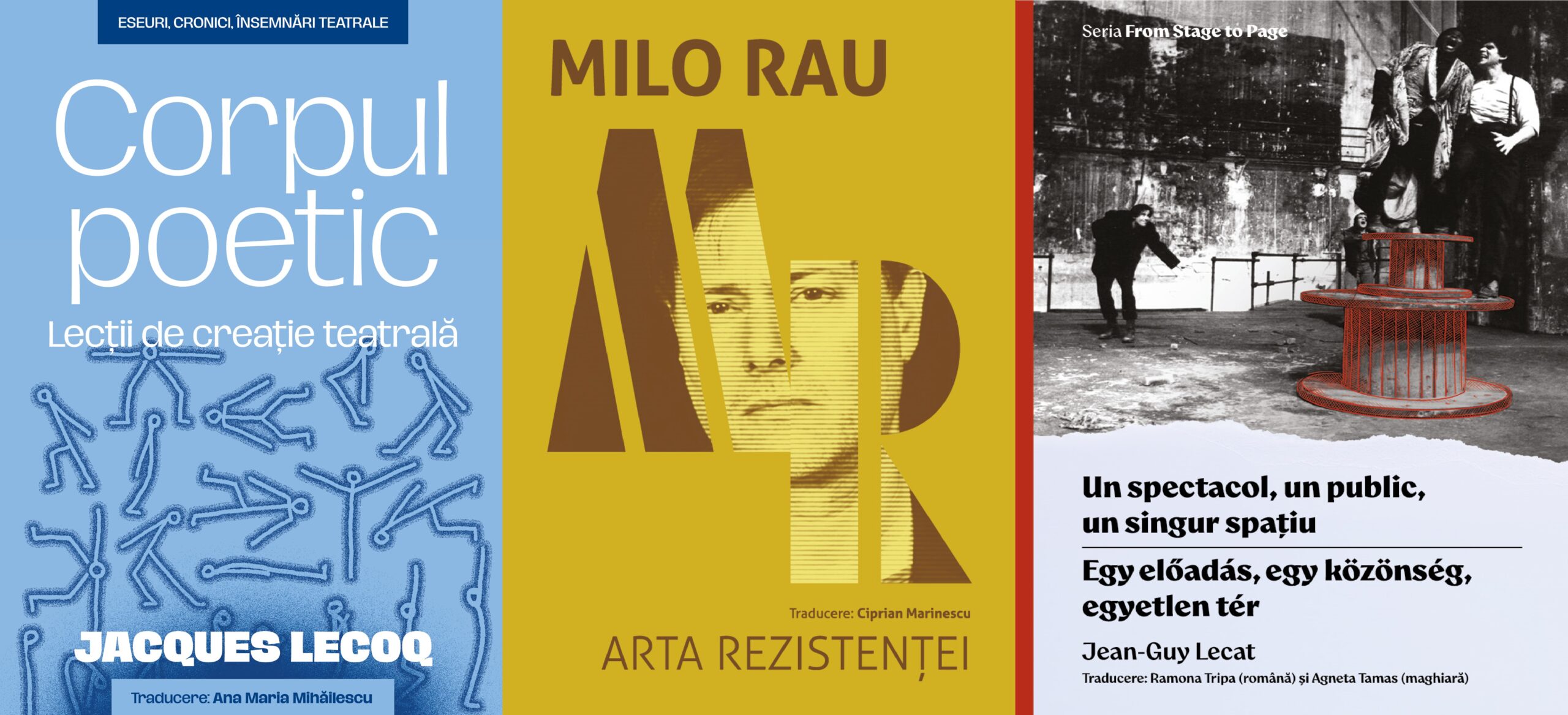
Jean-Guy Lecat
UN SPECTACOL, UN PUBLIC, UN SINGUR SPAȚIU | EGY ELŐADÁS, EGY KÖZÖNSÉG, EGYETLEN TÉR [A PERFORMANCE, AN AUDIENCE, A SINGLE SPACE]
Bilingual Romanian-Hungarian edition.
Translated from the French into Romanian by: Ramona Tripa
Translated from the English into Hungarian by: Agneta Tamas
The From Page to Stage series is produced in partnership by the “Camil Petrescu” Cultural Foundation and the Romanian OISTAT Centre (the International Organisation of Scenographers, Theatre Architects and Technicians). It aims to offer foundational books and scenography albums that fill a gap in Romanian theatre and performing-arts literature. The series seeks to build a steadily growing library of reference titles for professionals in the performing arts, giving them the theoretical and visual resources their professions cannot do without. The first volume to appear in the series was What Is Scenography? by Pamela Howard.
Jean-Guy Lecat is a legendary scenographer, recognised worldwide for transforming the relationship between theatre and its audience. For more than twenty-five years he was the principal scenographer and constant creative partner of the director Peter Brook. In that time, he turned over two hundred unconventional spaces around the globe into places of performance, from the reinvention of the Théâtre des Bouffes du Nord in Paris to the monumental sets for The Mahabharata. Lecat has received prestigious international awards for innovation in theatre architecture. In this book he shows how any space can become the living heart of the miracle of the stage.
Milo Rau
ARTA REZISTENȚEI [THE ART OF RESISTANCE]
Translated from the German by Ciprian Marinescu
Published with the support of ARCUB – Bucharest Municipality Cultural Centre.
Milo Rau’s The Art of Resistance is not merely a collection of essays and interviews but an invitation to reflect on how theatre becomes a space of responsibility: a place where aesthetics and political commitment do not exclude one another but intersect, and where the representation of violence becomes necessary to remind us who we are and to prepare us for a more peaceful world.
The volume brings together texts in which Rau examines his intellectual inheritance, from Hannah Arendt to the current forms of global realism, and shows how it translates into practice: in performances, films, trials, artistic encounters and international collaborations. An extensive conversation with the theatre critic Marijn Lems reveals concrete projects as well as dreams of a theatre that does not merely reflect reality but transforms it, from Rwanda to Iraq, and from the Brazilian Amazon to Switzerland and Belgium.
The preface by Sibylle Berg places Milo Rau’s work within the history of political art, underscoring the role of theatre in confronting the social and moral fragility of the present.
Poised between manifesto and confession, this volume reminds us that theatre is, ultimately, an art that allows us to live where revolutions have failed, but also a place where community reinvents itself and fiction becomes a political gesture.
MILO RAU is a Swiss director, playwright and theorist, known for international productions and films that blend documentary, political art and collective ritual. Through radical projects such as The Congo Tribunal, Orestes in Mosul and The Last Days of the Ceaușescus, Rau turns theatre into a space of ethical confrontation and reflection on contemporary reality. He is the initiator and a signatory of the Ghent Manifesto and, until 2024, was artistic director of NTGent, the city theatre of Ghent, in Belgium.
“Milo Rau is without doubt one of the most remarkable and best-known theatre directors and filmmakers of the moment. With productions such as Hate Radio, Five Easy Pieces and The New Gospel, Rau provokes and divides, stirs debate and touches with precision the hidden neuralgic points of our society.
How does Milo Rau think and work? What does his vision of a theatre of the future look like? And, above all, how can principles from the Ghent Manifesto, such as “It’s no longer just about depicting the world. It is about changing it”, be put into practice, in the artistic as well as the social sphere? The aim is not to depict the real, but to make the representation itself real. These are the questions that interested us and that we discussed among ourselves before getting in touch with Milo Rau. We are all the happier, indeed enthusiastic, that the texts gathered in this volume of essays offer us a new, extended and solid path of access to Milo Rau’s work. We found intelligent and nuanced answers to our various questions, as well as an abundance of material that can fuel even more discussion.
Studying Milo Rau’s texts in depth is a source of genuine pleasure. This is owed to his humour, his erudition, his theories grounded in experience, his appeal to compassion and imagination, and his formulations, which are often remarkably lucid. It gives us great pleasure to share with you, dear readers, the reflections and intelligent suggestions of Milo Rau contained in this volume.”
Anne Wieser and Bettina Spoerri (editors of the German-language edition), spring 2023
Jacques Lecoq
CORPUL POETIC. LECȚII DE CREAȚIE TEATRALĂ [THE POETIC BODY: LESSONS IN THEATRICAL CREATION]
Series: ESSAYS, CHRONICLES, THEATRE NOTES
Series editor: Octavian SZALAD
Translated from the French by: Ana Maria MIHĂILESCU
Original title: Le corps poétique
© Camil Petrescu Cultural Foundation for the Romanian-language edition (2026)
© Jacques Lecoq, in collaboration with Jean-Gabriel Carasso and Jean-Claude Lallias, Actes Sud, 1998
From “mimodynamics” to “geodramatics,” from the neutral mask to the great dramatic territories (melodrama, commedia dell’arte, buffoons, tragedy, clowns), Jacques Lecoq takes us on a journey through his School, inviting us to follow his entire pedagogical approach step by step.
“In the field of theatre pedagogy, Jacques Lecoq is a master in the truest sense of the word. A teacher with a clearly assumed view of the world and its movements, and of what is universal in theatre, he stood for some forty years as a “fixed point” that helped many students find their bearings, discover themselves, and “rise,” all the while respecting what was particular to each of them in culture, history, imagination, means, or talent.
These pages invite the reader on a patient and sure journey into the heart of the School’s two years. Focused on the principles that structure a theatre pedagogy developed through experience, the book took shape after many months of interviews. With his precise vocabulary, so rich in images, Jacques Lecoq leads us step by step to the limits of his own search: the sources of creation that can be shared by all. With patience and generosity, he explains, pointing out at the bends in the road the possible obstacles, slips, and dead ends… He remains alert, fascinated by certain enigmas in the relationship between man and the cosmos, enigmas from which theatrical play is born.”
Jean-Gabriel Carasso / Jean-Claude Lallias
JACQUES LECOQ (1921–1999) was one of the most influential theatre teachers of the twentieth century. As founder of his renowned Paris school (1956), he revolutionized the performing arts with the concept of physical theatre. Starting from sport and physiotherapy, Lecoq demonstrated that the laws of movement are inseparably bound to those of emotion. His original method, based on the observation of nature, the neutral mask, and the dynamics of the elements, transforms the actor from a mere interpreter into an autonomous creator. Lecoq’s legacy continues to shape contemporary theatre worldwide, having trained generations of artists who rediscovered that on stage, everything begins with a body in motion.